
.svg)
.svg)
Hiring today is shaped by rapid shifts in talent expectations, specialised skill demand, and the increasing role of technology in decision-making. With 54% of employees already using AI at work and 14% using it daily, recruitment is moving beyond traditional sourcing models toward more data-driven, technology-enabled approaches that redefine how talent is identified and evaluated.
This article breaks down the recent trends in recruitment shaping enterprise hiring trends in 2026, focusing on what actually matters in practice. Instead of surface-level observations, it explains how each trend impacts hiring strategy, where it fits, and how organisations can apply it effectively, especially when hiring across India and global markets like the USA and the UAE.
Key Takeaways
- Recruitment in 2026 is becoming more technology-driven, with over 65% of recruiters already using AI to improve sourcing efficiency and reduce hiring costs.
- Skills-based hiring is now mainstream, with 85% of employers prioritising skills over degrees, expanding access to non-traditional talent pools.
- Candidate expectations are reshaping hiring, with 83% of candidates saying a negative experience impacts their perception of a company, making process quality critical.
- Flexible workforce models are accelerating, with 36% of the global workforce engaged in freelance or contingent work, enabling faster scaling but requiring structured management.
- Data-driven and structured hiring approaches are delivering measurable outcomes, with organisations 2–3x more likely to improve quality of hire when using analytics and performance tracking.
What Are The Recent Trends In Recruitment And Why They Matter?
Recent trends in recruitment refer to the evolving ways organisations attract, assess, and hire talent in response to changing workforce expectations, technology adoption, and business priorities.
For enterprise hiring teams, these trends reflect a shift towards more structured, data-driven, and outcome-focused hiring models. From AI-led sourcing to skills-based hiring, recruitment is becoming more aligned with business performance rather than just role fulfilment.
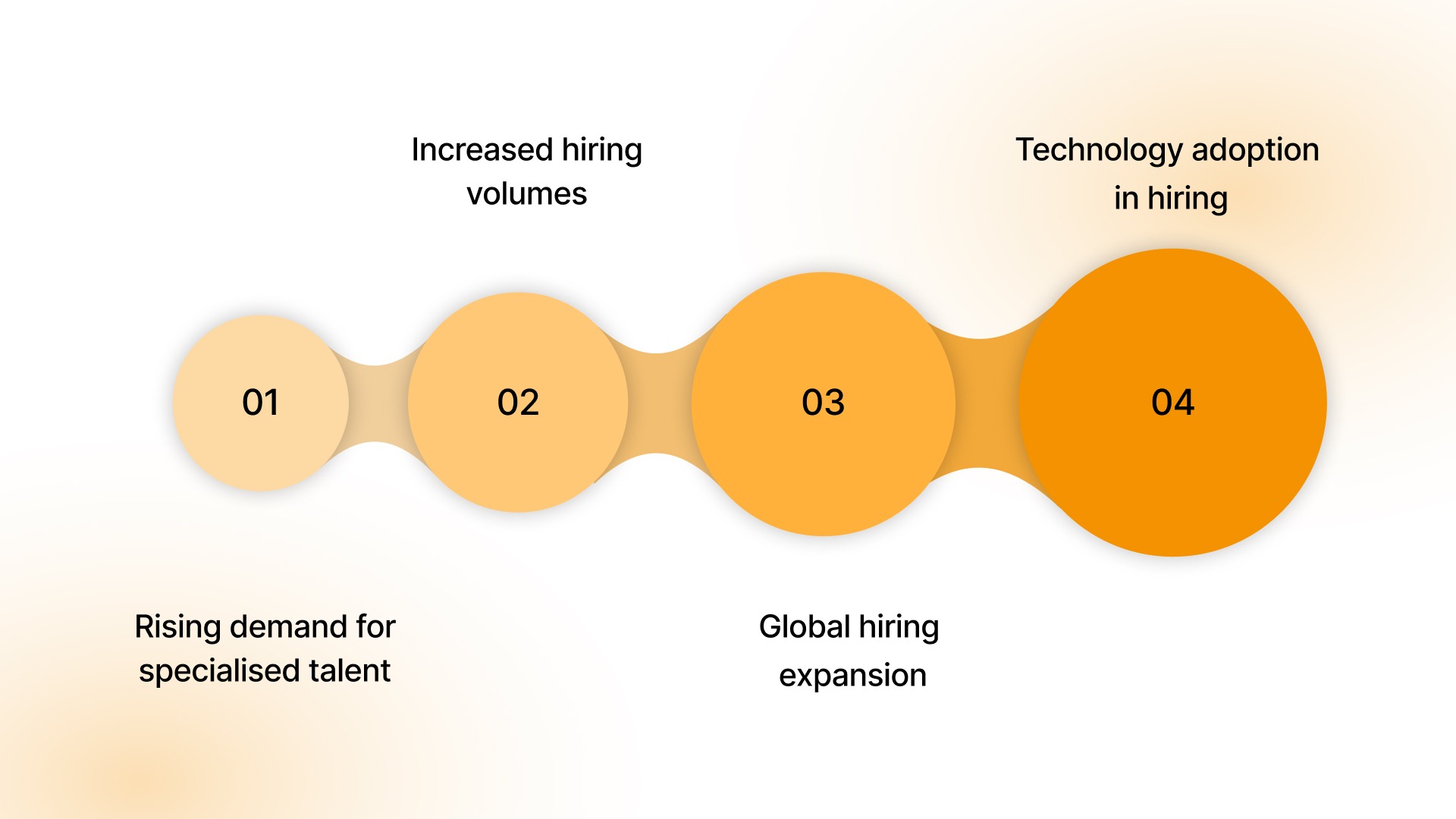
Several factors are driving these changes, particularly for large organisations and scaling teams:
- Rising demand for specialised talent: Roles in engineering, data, cloud, and AI/ML are harder to fill using traditional hiring methods.
- Increased hiring volumes: Enterprises are managing multiple roles across teams, locations, and business units.
- Global hiring expansion: Organisations are building teams across India and extending hiring into markets like the USA and the UAE.
- Technology adoption in hiring: AI and automation are reshaping sourcing, screening, and decision-making processes.
As a result, recruitment is no longer a linear process; it requires coordination across systems, teams, and geographies. Internal hiring teams often face limitations in bandwidth, visibility, and consistency, especially when hiring needs scale quickly or become more specialised.
What’s Driving Recruitment Trends In India In 2026?
India’s recruitment environment in 2026 is being shaped by strong hiring momentum, rapid digital transformation, and growing demand for specialised talent. Several recent data points highlight how enterprise hiring is evolving:
- White-collar hiring grew 9% in March 2026, with FY26 closing at +8%; the strongest growth in three years.
- India’s GCC (Global Capability Centre) workforce is expected to exceed 2 million employees by 2026, driven by expansion across technology, finance, and operations roles.
- Over 72% of employers in India report difficulty filling roles, particularly in areas like AI, cloud, and data.
- Demand for AI and data roles has grown by 30% year-on-year, especially in tier-1 cities such as Bengaluru, Hyderabad, and Pune.
- The flexi staffing industry is growing at a rate of ~15% annually, as enterprises adopt flexible workforce models to manage demand fluctuations.
Together, these trends show that recruitment in India is becoming more skill-driven, technology-enabled, and globally integrated. For enterprises, this means hiring strategies must evolve to balance speed, scale, and access to specialised talent while maintaining consistency and control.
For Talent Acquisition Heads and HR leaders, understanding these trends is critical, but applying them selectively is even more important. Not every trend will deliver value in every context. The focus should be on identifying which shifts improve hiring speed, candidate quality, and delivery predictability, while aligning with the organisation’s scale, role complexity, and long-term workforce strategy.

Top 15 Recent Trends In Recruitment Shaping Enterprise Hiring
Recruitment in 2026 is no longer defined by isolated tools or one-off process improvements. It is shaped by structural shifts in how organisations plan, execute, and scale hiring.
For enterprise teams, the following trends are not just emerging; they are actively influencing hiring outcomes, timelines, and workforce strategy.
Recruitment Trends In India: A Quick Summary
Together, these trends highlight the need for a balanced hiring strategy that combines speed, flexibility, and consistency.
For enterprises, the focus should be on selecting and applying the most relevant trends to improve hiring efficiency and long-term workforce outcomes.
Now, let's explore each of these trends in detail:
1. AI-Led Candidate Sourcing And Screening
AI-led sourcing and screening are changing how enterprises identify and prioritise talent. Instead of manual searches, AI tools analyse large datasets to match candidates with role requirements and streamline early-stage evaluation. While this improves efficiency, outcomes still depend on strong validation and human oversight.
With over 65% of recruiters already using AI, primarily to improve candidate sourcing and reduce hiring costs, this shift is becoming foundational rather than optional.
Key applications:
- Automated candidate matching: Identifying relevant candidates across platforms based on role criteria.
- Resume screening and ranking: Prioritising profiles by skills, experience, and fit.
- Pipeline prioritisation: Enabling recruiters to focus on high-fit candidates first.
AI-led sourcing reduces manual effort, accelerates shortlisting, and improves recruiter focus. For enterprise teams handling high volumes or specialised roles, it enables faster and more structured hiring; provided it is supported by consistent screening and decision-making processes.
Also Read: How India's AI Workforce is Shaping the Future of Jobs in 2026
2. Skills-Based Hiring Over Degree-Based Filtering
Skills-based hiring shifts the focus from formal qualifications to demonstrated capabilities. Instead of relying on degrees as a primary filter, enterprises evaluate candidates based on practical skills, project experience, and role-specific competencies; particularly important in areas like engineering, data, and cloud.
With 85% of employers now prioritising skills over degrees in hiring decisions, this shift is expanding access to non-traditional talent pools.
Key applications:
- Skill-first screening frameworks: Evaluating candidates based on technical and functional capabilities rather than academic background.
- Role-specific assessments: Using coding tests, case studies, or simulations to validate real-world skills.
- Expanded talent pools: Accessing candidates from non-traditional backgrounds who meet skill requirements.
This approach increases access to relevant talent, improves role fit, and reduces unnecessary filtering. For enterprise hiring teams, it leads to stronger candidate pipelines and better alignment between job requirements and actual performance on the job.
3. Candidate Experience As A Conversion Factor
Candidate experience has become a key factor in hiring success, especially in competitive talent markets. Beyond compensation, candidates evaluate how efficiently and professionally the hiring process is managed; from initial outreach to final offer.
Candidate experience has become critical, with 83% of candidates saying a negative hiring experience can change their perception of a company.
Key applications:
- Streamlined interview processes: Reducing delays and unnecessary interview rounds.
- Clear communication: Providing timely updates and transparent expectations throughout the hiring cycle.
- Structured candidate engagement: Maintaining consistency in interactions across recruiters and hiring managers.
A strong candidate experience improves offer acceptance rates and reduces drop-offs during the hiring process. For enterprise teams, it leads to faster closures and a more reliable hiring pipeline, particularly when competing for in-demand talent.
4. Employer Branding As A Hiring Lever
Employer branding has become a critical factor in attracting and converting talent, especially for specialised and competitive roles. Candidates increasingly evaluate organisations based on reputation, work culture, and growth opportunities before engaging in the hiring process.
Employer branding directly impacts hiring outcomes, with 75% of candidates researching a company’s reputation before applying.
Key applications:
- Brand positioning across channels: Showcasing company culture, projects, and employee experiences on platforms like LinkedIn and career pages.
- Candidate engagement strategies: Communicating value proposition clearly during outreach and interviews.
- Content-driven hiring support: Using case studies, employee stories, and thought leadership to attract talent.
A strong employer brand reduces sourcing effort, improves candidate engagement, and increases offer acceptance rates. For enterprise teams, it creates a more consistent and effective hiring pipeline, particularly for hard-to-fill roles.
5. Data-Driven Hiring Decisions
Recruitment is increasingly guided by data rather than intuition. Enterprises are using hiring metrics and analytics to track pipeline performance, identify bottlenecks, and improve decision-making across the recruitment process.
Organisations using data-driven hiring are 2–3x more likely to improve quality of hire and reduce hiring inefficiencies.
Key applications:
- Pipeline analytics: Tracking conversion rates across sourcing, screening, and interviews.
- Performance dashboards: Monitoring time-to-hire, source effectiveness, and recruiter productivity.
- Predictive hiring insights: Using historical data to forecast hiring timelines and outcomes.
Data-driven hiring improves visibility and consistency in recruitment. For enterprise teams, it enables better planning, faster issue identification, and more predictable hiring outcomes; provided the data is accurate and consistently tracked.
6. Faster Hiring Cycles And Reduced Time-To-Hire
Enterprises are under increasing pressure to shorten hiring cycles as competition for talent intensifies. Delays in decision-making or extended interview processes can lead to candidate drop-offs, especially for in-demand roles.
Speed is now a competitive advantage, with top candidates off the market within 10 days on average.
Key applications:
- Streamlined interview stages: Reducing unnecessary rounds and aligning stakeholders early.
- Faster decision workflows: Improving coordination between recruiters and hiring managers.
- Pre-built talent pipelines: Maintaining ready-to-engage candidates for critical roles.
Shorter hiring cycles improve offer acceptance rates and reduce the risk of losing candidates to competitors. For enterprise teams, it leads to quicker role closures and a more responsive hiring process without compromising on quality when managed effectively.
7. Growth Of Contract And Flexible Workforce Models
Enterprises are increasingly adopting contract and flexible workforce models to respond to changing business needs. Instead of relying solely on permanent hiring, organisations are building teams that can scale up or down based on project demands, especially in technology and operations functions.
Flexible workforce models are expanding rapidly, with 36% of the global workforce already engaged in freelance or contingent work.
Key applications:
- Contract staffing for project needs: Hiring talent for defined durations based on workload or project timelines.
- Flexible workforce scaling: Adjusting team size quickly without long-term commitments.
- Blended workforce models: Combining permanent employees with contract talent for operational flexibility.
Flexible workforce models enable faster scaling and better cost control. For enterprise teams, this approach improves agility in hiring while maintaining access to specialised skills, particularly in dynamic or high-demand environments.
8. Rise Of Global And Cross-Border Hiring
Hiring is no longer limited to a single geography. Enterprises are building teams across India while expanding into markets like the USA and the UAE to access wider talent pools. While this improves availability and flexibility, it also introduces added complexity in compliance, compensation structures, and workforce management.
Global hiring is accelerating, with over 57% of leading organisations now hiring talent across borders to address skill shortages.
Key applications:
- Multi-country talent sourcing: Identifying and hiring candidates across India, the USA, and the UAE based on role requirements.
- Remote and distributed team building: Creating cross-border teams without requiring physical relocation.
- EOR and compliance-driven hiring: Managing employment, payroll, and regulations across different geographies.
Global hiring expands access to specialised talent and supports faster scaling across regions. For enterprise teams, it enables flexibility in workforce planning, but requires structured processes and compliance frameworks to ensure consistent and risk-free execution.
9. Internal Mobility And Talent Redeployment
Enterprises are placing greater emphasis on internal mobility to fill roles using existing talent. Instead of relying solely on external hiring, organisations are identifying employees who can transition into new roles based on skills, experience, and potential.
Key applications:
- Internal talent marketplaces: Platforms that match employees to open roles or projects within the organisation.
- Skill mapping and visibility: Tracking employee capabilities to identify redeployment opportunities.
- Upskilling and reskilling initiatives: Preparing internal talent for evolving role requirements.
Internal mobility reduces dependency on external hiring and shortens time-to-fill for certain roles. For enterprise teams, it improves retention, optimises workforce utilisation, and creates a more flexible and responsive talent strategy.
10. Integration Of HR Tech Platforms
Recruitment is increasingly supported by integrated HR tech ecosystems, where tools such as Applicant Tracking Systems (ATS), CRM platforms, and analytics solutions work together. This integration improves visibility across the hiring process and enables better coordination between recruiters, hiring managers, and stakeholders.
HR tech adoption is rising, with over 75% of organisations investing in integrated HR systems to improve hiring efficiency.
Key applications:
- ATS and CRM integration: Managing candidate pipelines and engagement in a unified system.
- Centralised hiring data: Consolidating information across sourcing, screening, and interviews.
- Cross-team collaboration tools: Enabling seamless coordination between TA teams and business units.
Integrated HR tech improves process consistency and decision-making. For enterprise teams, it enables better tracking, reduces information gaps, and supports more efficient hiring workflows across multiple roles and locations.
11. Increased Demand For Niche Tech Roles
Enterprises are seeing a sharp rise in demand for specialised technology roles, particularly in areas like AI/ML, cloud, data engineering, and cybersecurity. These roles require specific skill sets and experience, making them harder to fill through traditional sourcing methods and often extending hiring timelines.
Key applications:
- Targeted talent sourcing: Focused outreach to candidates with specialised technical expertise.
- Niche role pipelines: Building dedicated pipelines for hard-to-fill roles across functions like data, cloud, and security.
- Specialist screening processes: Using technical assessments and domain-specific evaluation methods.
This trend pushes organisations to adopt more focused and structured hiring approaches. For enterprise teams, it leads to better alignment between role requirements and candidate capabilities, but also requires deeper market understanding and stronger sourcing strategies to maintain hiring speed and quality.
12. Shift Towards Outcome-Based Hiring Metrics
Enterprises are moving beyond traditional recruitment metrics like time-to-hire and focusing on outcomes that reflect business impact. This includes measuring quality of hire, retention, and on-the-job performance to assess how effectively hiring contributes to organisational goals.
Key applications:
- Quality of hire tracking: Evaluating performance and retention of new hires over time.
- Role success metrics: Linking hiring outcomes to business performance indicators.
- Post-hire analysis: Reviewing hiring decisions to improve future recruitment strategies.
Outcome-based metrics provide a more accurate view of hiring effectiveness. For enterprise teams, this leads to better decision-making, improved long-term workforce quality, and stronger alignment between recruitment and business performance.
13. Diversity And Inclusion Hiring Focus
Diversity and inclusion in hiring has evolved from a compliance requirement to a structured, process-driven priority for enterprises. Organisations are focusing on building more balanced teams by embedding fairness and consistency into how candidates are sourced, evaluated, and selected.
Diversity remains a priority, with 76% of job seekers considering diversity when evaluating job offers.
Key applications:
- Structured interview frameworks: Standardising evaluation criteria to reduce bias across hiring stages.
- Diverse sourcing strategies: Expanding outreach to underrepresented talent pools.
- Inclusive hiring processes: Designing job descriptions and assessments that attract a broader range of candidates.
A structured approach to diversity and inclusion improves access to wider talent pools and ensures more consistent hiring decisions. For enterprise teams, it leads to stronger team composition, better representation, and more objective, repeatable hiring outcomes.
Taken together, these trends reflect a broader shift: recruitment is becoming more structured, data-driven, and aligned with business outcomes. For enterprise teams, the challenge is not adopting every trend, but identifying which ones directly improve hiring effectiveness and scalability.
14. Recruitment Process Outsourcing (RPO) Adoption
Recruitment Process Outsourcing (RPO) is gaining traction as enterprises look for more structured and scalable hiring models. Instead of managing recruitment entirely in-house, organisations partner with RPO providers to handle part or all of the hiring process, embedding dedicated teams and standardised workflows into their operations.
RPO adoption is increasing, with over 62% of enterprises using outsourcing models to scale hiring operations.
Key applications:
- Embedded recruitment teams: Dedicated recruiters working within the organisation’s hiring framework.
- End-to-end hiring management: Handling sourcing, screening, coordination, and reporting.
- SLA-driven delivery models: Structured timelines, performance tracking, and accountability.
RPO enables enterprises to scale hiring consistently while improving visibility and control over recruitment processes. It reduces pressure on internal teams and brings predictability to hiring outcomes, especially in high-volume or ongoing recruitment scenarios.
15. Automation In Recruitment Workflows
Automation is increasingly used to streamline repetitive tasks within recruitment, allowing teams to operate more efficiently. From scheduling interviews to managing candidate communication, automation reduces manual effort and helps standardise hiring processes at scale.
Automation is becoming standard, with up to 44% of recruitment tasks expected to be automated in the coming years.
Key applications:
- Interview scheduling automation: Coordinating calendars and reducing back-and-forth communication.
- Automated candidate communication: Sending updates, reminders, and status notifications.
- Workflow management: Standardising stages such as application tracking, follow-ups, and documentation.
Automation improves operational efficiency and reduces administrative workload for recruiters. For enterprise teams, it enables faster process execution and greater consistency across hiring workflows, while allowing recruiters to focus on higher-value activities like evaluation and decision-making.

Also Read: 8 AI-Based Hiring Methods That Cut Recruitment Time in Half (2026)
How These Recruitment Trends Impact Enterprise Hiring Strategy
Recruitment trends are not just changing how hiring is executed; they are reshaping how enterprise teams plan and manage talent acquisition at a strategic level.

As hiring becomes more complex, global, and skill-driven, organisations are moving away from reactive approaches and adopting more structured, forward-looking models.
Shift From Reactive Hiring To Workforce Planning
Enterprises are moving from role-by-role hiring to pipeline-based workforce planning. Instead of opening roles only when a need arises, organisations are building ongoing talent pipelines aligned to business goals, growth plans, and future skill requirements. This shift improves readiness and reduces delays in filling critical positions.
Increased Need For Scalable Hiring Models
As hiring volumes grow and roles become more specialised, internal teams alone often struggle to keep up. Enterprises are increasingly adopting scalable hiring models, such as RPO and contract staffing, to manage demand across multiple functions and locations. This ensures consistency in delivery without overburdening internal resources.
Greater Focus On Predictability And Reporting
With higher hiring stakes, organisations are placing greater emphasis on predictability and transparency in recruitment. This includes structured reporting, clear pipeline visibility, and SLA-driven hiring models that define timelines and performance expectations.
Such frameworks help enterprises track progress, identify bottlenecks, and maintain control over hiring outcomes.
Which Trends Matter Most For Different Hiring Contexts (GCCs, Startups, MNCs)
Recruitment trends do not apply equally across organisations. Their relevance depends on hiring scale, growth stage, and geographic footprint.
For enterprise hiring leaders, the focus should be on selecting trends that align with operational needs and execution capability; not adopting them uniformly.
GCC Hiring Priorities
Global Capability Centres (GCCs) in India are focused on scaling offshore teams while maintaining global standards. This requires structured, high-volume hiring across specialised roles such as engineering, data, and operations.
Key trends that matter most:
- Skills-based hiring: To access wider, capability-driven talent pools.
- RPO and scalable hiring models: To manage volume and ensure consistency.
- Data-driven hiring: For visibility across pipelines and performance.
GCCs benefit from trends that improve process standardisation, predictability, and scale, while aligning with global hiring frameworks.
Startup Hiring Priorities
Startups operate in high-growth environments where speed and flexibility are critical. Hiring decisions are often time-sensitive, and teams need to scale quickly without complex processes slowing them down.
Key trends that matter most:
- Faster hiring cycles: To secure talent before competitors.
- Contract and flexible hiring: To scale without long-term commitments.
- Targeted sourcing strategies: For niche roles in product and engineering.
Startups benefit from trends that enable agility and quick execution, but must balance speed with basic structure to maintain hiring quality.
MNC Hiring Priorities
Multinational corporations (MNCs) prioritise consistency across regions, especially when hiring across India, the UAE, and the USA. Hiring needs to align with global standards while adapting to local market conditions.
Key trends that matter most:
- Global and cross-border hiring: To build distributed teams.
- Integrated HR tech platforms: For unified tracking and coordination.
- SLA-driven hiring models: To ensure predictability and accountability.
MNCs benefit from trends that support standardisation, compliance, and coordinated execution across geographies and business units.
How V3 Staffing Helps Enterprises Navigate Recruitment Trends
As recruitment becomes more complex, adopting trends alone is not enough; enterprises need a partner that can translate these shifts into consistent hiring execution. V3 Staffing supports organisations in operationalising recruitment trends such as AI-led sourcing, skills-based hiring, and global workforce expansion through structured, scalable delivery models.
V3 Staffing works with GCCs, MNCs, and high-growth teams to build hiring engines that align with evolving talent demands, particularly across engineering, product, data, cloud, AI/ML, and cybersecurity roles. With delivery across India and active hiring capabilities in the USA and the UAE, it enables organisations to manage both domestic and cross-border hiring with greater control and predictability.
Key areas of support include:
- Permanent recruitment: End-to-end hiring for mid to senior-level roles with domain-aligned sourcing and evaluation.
- IT staffing: Specialised hiring for engineering, cloud, data, AI/ML, and cybersecurity talent.
- Contract staffing: Flexible workforce solutions for project-based or high-volume hiring needs.
- Recruitment Process Outsourcing (RPO): Embedded teams with SLA-driven delivery, reporting, and pipeline management.
- Executive search: Targeted hiring for leadership roles across CXO, VP, and senior management levels.
- Global hiring & EOR services: Compliant hiring and workforce management across India, the USA, and the UAE.
By combining structured processes, domain expertise, and SLA-driven accountability, V3 Staffing helps enterprises move from reactive hiring to predictable, scalable recruitment outcomes.
Conclusion
Organisations looking to stay competitive in 2026 need more than awareness of recruitment trends; they need the ability to apply the right ones in a way that supports scale, speed, and consistency. This requires a structured approach that connects hiring strategy with execution, rather than relying on isolated tools or short-term fixes.
For enterprises navigating these shifts, V3 Staffing supports hiring across permanent recruitment, IT staffing, contract staffing, RPO, leadership hiring, EOR, and global hiring models; helping teams translate recruitment trends into consistent, scalable outcomes across India and markets like the USA and the UAE.
If you are assessing which recruitment trends to adopt or how to align them with your hiring strategy, V3 Staffing can help you identify the approach that best fits your current needs and growth plans.
Contact us to explore the right path forward.