
.svg)
.svg)
Most hiring slowdowns are not caused by talent shortages. They happen when organisations pick the wrong staffing model and realise it only after project timelines slip, cloud migrations pause, or product launches miss their window.
Across engineering, product, and infrastructure teams, leaders are no longer asking whether talent exists. They are asking whether their hiring structure matches the work ahead.
Skill gaps are already the biggest barrier to business transformation for 63% of employers globally, which explains why companies are increasingly combining permanent, contract, and project-based staffing rather than relying on a single hiring route.
So if you needed to scale teams within 60 days, which staffing model would actually support speed without increasing hiring risk?
This guide explains the core staffing models, how they differ, when each model fits best, and how organisations apply them in real hiring scenarios today.
Key Takeaways
- Six main types of staffing used by organisations are permanent, contract, temporary, contract-to-hire, staff augmentation, and RPO. Each supports different timelines and ownership needs.
- Permanent staffing fits long-term capability ownership, contract staffing supports transformation work, and temporary staffing manages short-term workload spikes.
- Most enterprises now combine multiple staffing models across engineering, cloud, data, AI, and cybersecurity programmes instead of relying on one pipeline.
- The right staffing choice depends on duration of need, skill scarcity, hiring urgency, internal recruitment bandwidth, and expansion geography.
What Does “Staffing” Actually Include Today?
Staffing now covers far more than vacancy filling. It includes capability planning, pipeline design, deployment timing, and role alignment with programme outcomes. Organisations treat staffing as a delivery mechanism rather than an HR activity.

Four workforce layers typically sit inside a modern staffing strategy.
1. Internal Staffing
Internal staffing focuses on redeployment and progression within the existing workforce. It helps retain institutional knowledge and reduces onboarding time for strategic roles.
Common examples include:
- Moving backend engineers into platform ownership roles
- Promoting delivery managers into programme leadership
- Expanding analytics teams through internal reskilling
Internal staffing works best where domain familiarity matters more than rapid scaling speed.
2. External Staffing
External staffing introduces talent from outside the organisation through permanent hiring, contract engagement, or specialist sourcing partners.
Typical use cases include:
- Building AI capability from scratch
- Expanding cybersecurity readiness programmes
- Launching GCC engineering pods
External staffing improves access to scarce technical capability.
3. Project-Based Staffing
Project-based staffing supports delivery milestones with defined timelines and specialist requirements.
Examples include:
- SAP migration programmes
- Data platform rebuilds
- Mobile application release cycles
This approach reduces long-term workforce cost exposure.
4. Strategic Workforce Expansion
Strategic workforce expansion supports multi-year growth plans across new geographies or business lines.
Examples include:
- Establishing India GCC delivery centres
- Scaling cloud platform engineering capacity
- Expanding analytics teams for regulatory reporting
Once organisations move beyond traditional hiring pipelines, selecting the right staffing type becomes a structured workforce decision rather than an operational HR task.
Also Read: What Is a Staffing Recruiter? Roles, Skills, and Hiring Process
What Are The Main Types Of Staffing Used By Organisations Today?
Enterprises rely on six primary staffing structures depending on execution timelines, skill availability, and programme ownership requirements.
1. Permanent Staffing
Permanent staffing supports capability ownership across business-critical systems and leadership functions. It strengthens continuity in product engineering, enterprise architecture, and security governance.
Permanent hiring works best when organisations need:
- Long-term platform ownership
- Product roadmap continuity
- Leadership accountability
Example: A fintech company expanding digital lending infrastructure typically hires permanent backend engineers and fraud analytics specialists to maintain regulatory compliance and stability.
Permanent staffing improves retention but increases fixed workforce commitments.
2. Contract Staffing
Contract staffing supports delivery programmes that require specialist expertise for defined timelines. Organisations frequently apply contract hiring during transformation phases.
Typical contract staffing scenarios include:
- Cloud infrastructure migration
- AI model deployment
- Cybersecurity audit remediation
3. Temporary Staffing
Temporary staffing supports short-duration workforce requirements driven by operational spikes or transition periods.
Temporary staffing is often used for:
- Programme rollout support
- Release cycle assistance
- Interim operational continuity
Example: During ERP transitions, organisations frequently deploy temporary QA analysts to maintain testing coverage while permanent teams shift focus to integration layers.
Temporary staffing improves response speed during workload surges.
4. Contract To Hire Staffing
Contract-to-hire staffing enables evaluation before conversion into permanent employment. It reduces hiring risk in environments with uncertain capabilities.
This model works well when organisations:
- Launch new delivery verticals
- Expand into unfamiliar technology stacks
- Test leadership fit in new regions
Example: A GCC setting up product analytics capability may initially engage contract analysts before confirming long term ownership roles. Contract to hire improves selection accuracy.
5. Staff Augmentation
Staff augmentation extends internal engineering and product delivery capacity without restructuring organisational hierarchy.
It supports:
- Platform modernisation
- DevOps pipeline expansion
- Data warehouse optimisation
Example: A logistics company accelerating route optimisation models may augment internal teams with Python engineers and cloud data architects. Augmentation improves delivery velocity without changing reporting structures.
6. Recruitment Process Outsourcing RPO
Recruitment process outsourcing transfers partial or full ownership of recruitment to a specialist hiring partner. It supports structured scale hiring across multiple functions.
RPO programmes typically include:
- Workforce planning support
- Pipeline forecasting
- Offer conversion tracking
- Reporting dashboards
Example: A shared services centre expanding finance analytics and infrastructure engineering teams simultaneously often uses RPO to stabilise pipeline consistency.
RPO improves hiring predictability during multi-role expansion phases.
Also Read: 11 Best Recruitment Startups Transforming the Hiring Industry
Permanent Vs Contract Vs Temporary Staffing: What Is The Difference?
These three models differ most clearly across duration, cost exposure, onboarding speed, and knowledge retention outcomes.
The comparison below explains where each structure fits best.
Understanding these differences helps organisations prevent capability mismatches during scaling phases.
Duration And Workforce Stability
Permanent staffing supports long horizon programme ownership. Contract staffing supports execution phases. Temporary staffing maintains operational continuity during transition windows.
Example: During cloud migration, architects often join as contract specialists, while platform reliability engineers remain permanent hires.
Cost Structure And Budgeting Impact
Permanent hiring increases baseline payroll commitments. Contract staffing aligns cost with transformation timelines. Temporary staffing supports short-duration operational flexibility.
Finance leaders often combine these models to maintain cost predictability during multi-quarter delivery programmes.
Speed Of Hiring And Deployment
Contract staffing provides faster access to scarce expertise. Temporary staffing enables immediate workforce reinforcement. Permanent hiring involves deeper evaluation cycles and leadership approvals.
Example: Cybersecurity incident response teams often deploy contract specialists within weeks rather than months.
Control Ownership And Retention Outcomes
Permanent teams maintain institutional memory. Contract specialists deliver targeted technical expertise. Temporary hires stabilise workload continuity without long term retention expectations.
Each model contributes differently to organisational capability depth.
Also Read: Challenges in Leadership Hiring: Common Issues and Solutions
Which Type Of Staffing Fits Different Business Situations Best?
Selecting the right staffing structure depends less on headcount targets and more on the timing of the capability lifecycle. Organisations that align staffing type with programme phase usually reduce delivery delays and hiring rework.
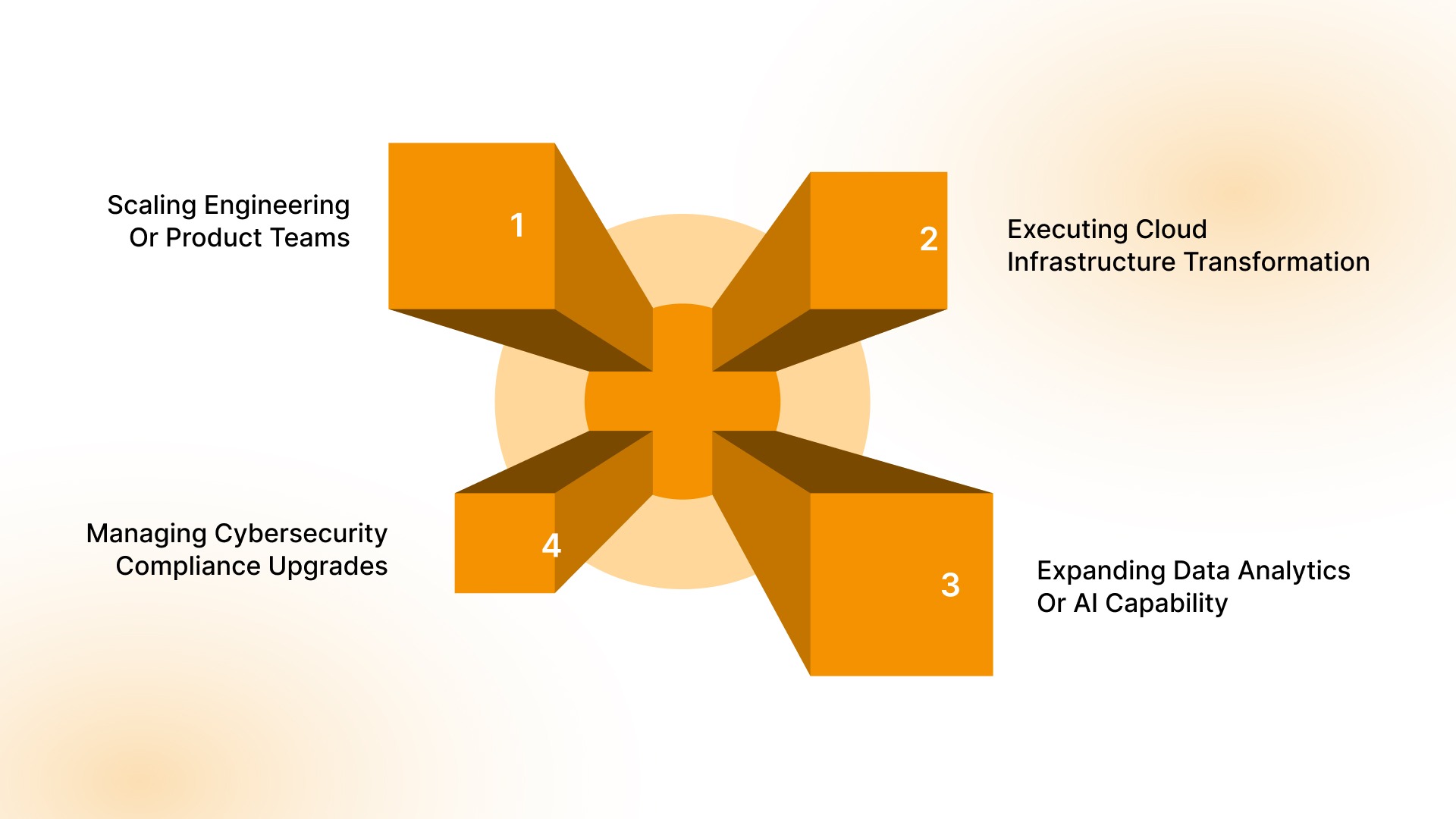
Three variables shape the decision:
- Duration of ownership required
- Scarcity of capability in the market
- Operational impact of hiring slips
Many engineering and analytics programmes fail to meet timelines, not because talent is unavailable, but because the workforce structure is misaligned with execution stages.
The scenarios below show how organisations match staffing models to delivery priorities across engineering, cloud infrastructure, analytics pipelines, and cybersecurity governance.
1. Scaling Engineering Or Product Teams
Engineering expansion rarely happens in a single hiring wave. Platform maturity moves through architecture build, feature acceleration, and reliability ownership stages. Each stage requires a different staffing structure.
A typical scaling sequence looks like this:
- Permanent engineers stabilise architecture layers
- Augmented developers increase release throughput
- Contract specialists address performance bottlenecks
Example: A SaaS company expanding API infrastructure usually hires permanent backend engineers to own service orchestration while augmenting frontend delivery capacity to meet release milestones.
This layered staffing pattern is becoming more common as product teams shift to continuous delivery models.
Many enterprise hiring leaders combine multiple types of staffing with support from partners such as V3 Staffing when internal recruitment teams cannot scale fast enough across engineering product data cloud and cybersecurity hiring programmes.
2. Executing Cloud Infrastructure Transformation
Cloud migration introduces short duration architecture requirements followed by long duration platform ownership needs. Treating both stages as permanent hiring creates unnecessary cost exposure.
Organisations typically structure cloud transformation staffing in phases:
Example: A retail enterprise moving workloads to Azure frequently deploys contract cloud engineers during migration windows before transferring ownership to permanent site reliability teams.
This approach reduces idle specialist capacity after migration completion.
3. Expanding Data Analytics Or AI Capability
Analytics capability grows through experimentation cycles before stabilising into production infrastructure. Staffing models must reflect that progression.
Typical analytics staffing progression includes:
- Contract data scientists during experimentation
- Augmented data engineers during pipeline scaling
- Permanent analytics owners after model deployment
Example: A banking analytics team implementing fraud detection models frequently engages contract machine learning engineers before establishing permanent ownership structures.
4. Managing Cybersecurity Compliance Upgrades
Cybersecurity transformation programmes follow regulatory timelines rather than product release cycles. Staffing must match audit schedules and remediation deadlines.
Organisations usually structure cybersecurity staffing across two layers:
- Contract penetration testing specialists for audit preparation
- Permanent governance engineers for policy continuity
Example: Financial institutions preparing for zero trust architecture rollouts often engage contract compliance specialists first, followed by permanent security engineering teams.
Flexible staffing is becoming standard in this domain. By 2026, one in four GCC roles is expected to be contractual, reflecting rising demand for specialist capability during transformation cycles.
How Should Organisations Choose The Right Staffing Model?
Staffing selection works best when aligned with capability duration rather than vacancy urgency. Organisations that apply structured selection criteria reduce hiring churn and improve programme predictability.
Four evaluation checkpoints improve decision accuracy.
1. Define The Duration Of Capability Need
Short execution windows support contract staffing. Long ownership horizons support permanent hiring.
Example: Database migration programmes rarely justify permanent hiring for legacy platform specialists once transition milestones are complete.
Programme timelines should always determine staffing structure before role approval begins.
2. Assess Availability Of Specialised Skills
Scarcity directly affects hiring speed. Rare capability areas typically require contract sourcing or augmentation support.
High scarcity domains currently include:
- Kubernetes platform engineering
- AI model optimisation
- Cloud security architecture
- Data platform orchestration
Specialist hiring shortages continue to influence staffing decisions globally. Skills gaps remain the largest transformation barrier for most employers, according to workforce studies from international labour research bodies.
3. Evaluate Internal Recruitment Bandwidth
Pipeline ownership becomes difficult when multiple capability tracks expand simultaneously. Internal recruitment teams often struggle to maintain visibility across engineering analytics and infrastructure hiring programmes.
Example: A GCC scaling three engineering pods simultaneously frequently transfers pipeline ownership to RPO teams to stabilise hiring throughput.
Structured recruitment delivery improves forecasting accuracy across large-scale hiring programmes.
4. Consider Geographic Hiring Expansion Plans
Cross-border hiring introduces payroll taxation, statutory compliance, and employment classification complexity that internal teams rarely manage at scale.
Employer of Record structures help organisations deploy talent across new regions without establishing legal entities first.
Also Read: GCC Outsourcing vs Traditional Outsourcing Explained
Why Organisations Now Combine Multiple Types Of Staffing Instead Of Choosing One
Enterprise workforce design increasingly reflects delivery architecture rather than organisational hierarchy. Programmes rarely rely on a single staffing model today.
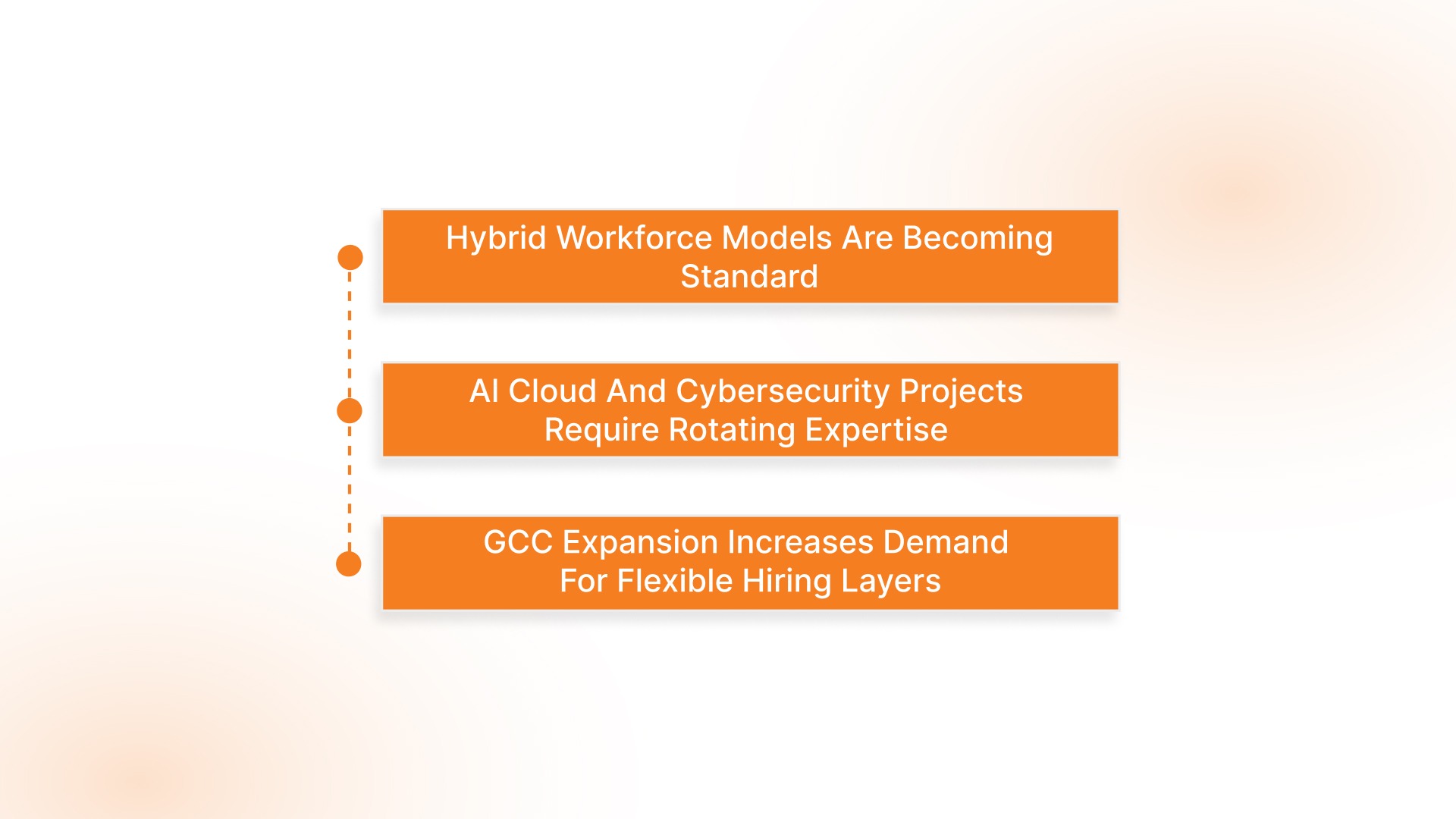
This shift is evident across engineering analytics and infrastructure-delivery environments.
1. Hybrid Workforce Models Are Becoming Standard
Permanent teams maintain platform ownership continuity. Contract specialists support transformation execution phases.
Example: Financial institutions frequently maintain permanent security engineering teams while engaging contract penetration testing specialists during audit cycles.
Hybrid workforce structures reduce idle specialist capacity between programme phases.
2. AI Cloud And Cybersecurity Projects Require Rotating Expertise
Capability requirements change as transformation programmes move from design to deployment to optimisation.
Organisations adjust workforce composition across these phases rather than maintaining static hiring structures.
Example: AI deployment programmes often begin with contract data scientists before transitioning ownership to permanent analytics engineers.
This phased staffing approach improves both cost control and continuity of capability.
3. GCC Expansion Increases Demand For Flexible Hiring Layers
Global Capability Centres now operate as innovation hubs rather than support units. Their staffing strategies increasingly combine permanent engineering ownership with contract transformation capacity.
Structured workforce partners such as V3 Staffing help organisations combine permanent hiring, contract staffing, RPO delivery, and EOR support into one coordinated staffing strategy aligned with programme timelines. Connect with V3 Staffing to plan a workforce model that supports faster scaling across engineering, product, data, cloud, and cybersecurity teams.
What Mistakes Organisations Make When Selecting Staffing Models
Workforce structure decisions often determine whether programmes scale predictably or stall mid execution. The mistakes below appear repeatedly across engineering analytics and infrastructure hiring environments.
1. Choosing Permanent Hiring For Short Lifecycle Initiatives
Permanent hiring increases fixed workforce cost when capability demand exists only during transformation windows.
Example: Hiring permanent SAP migration specialists often creates underutilised capacity after implementation completion. Transformation staffing should follow lifecycle milestones rather than organisational structure.
2. Using Contract Staffing for Ownership-Driven Leadership Roles
Contract leadership reduces accountability continuity across long horizon programmes.
Example: Platform architecture ownership typically requires permanent alignment with leadership. Leadership stability improves delivery governance across multi-year infrastructure initiatives.
3. Ignoring Onboarding Timelines In Urgent Hiring Plans
Delayed onboarding frequently disrupts release cycles when staffing decisions occur late in execution planning.
Example: Cybersecurity compliance programmes often underestimate specialist onboarding timelines. Hiring timelines should be planned alongside programme scheduling rather than after approval stages.
4. Overlooking Compliance Complexity in Cross-Border Hiring
Global workforce deployment introduces payroll taxation, statutory obligations, and employment classification exposure that internal hiring teams often underestimate. Employer of Record structures reduce compliance risk during international expansion.
5. Scaling Without Workforce Planning Visibility
Fragmented pipeline tracking leads to hiring duplication, role overlap, and delayed delivery coordination across engineering pods.
Example: Engineering teams expanding independently without shared workforce planning frequently compete for identical specialist roles across infrastructure and analytics functions.
Organisations that align staffing structure with capability timelines consistently achieve stronger delivery predictability across engineering, product analytics, and infrastructure programmes.

How V3 Staffing Supports Organisations Across Different Types Of Staffing
Selecting the right mix of staffing models becomes difficult when hiring demand spans engineering, product, data, cloud, AI, and cybersecurity roles simultaneously. This is where a structured workforce partner adds clarity to execution.
V3 Staffing works with enterprise teams, GCC leaders, and scaling organisations that need predictable hiring delivery across multiple staffing formats rather than isolated recruitment support.
V3 aligns staffing strategy with programme timelines through:
- Permanent Recruitment: Builds stable ownership across engineering, product, analytics, and infrastructure functions where continuity matters.
- Contract Staffing: Deploys specialist talent quickly for transformation initiatives such as cloud migration, cybersecurity upgrades, and platform modernisation.
- Recruitment Process Outsourcing (RPO): Manages end-to-end hiring pipelines with structured reporting, forecasting visibility, and SLA driven delivery across multi-role expansion programmes.
- Leadership Hiring: Supports targeted search for senior roles that shape delivery governance, capability direction, and regional expansion priorities.
- Employer Of Record (EOR): Enables compliant workforce deployment across India, the USA, and the UAE without requiring immediate legal entity setup.
Conclusion
Staffing is moving away from fixed headcount expansion toward capability-based workforce design. Organisations are structuring teams around project timelines, platform ownership needs, and access to specialised skills rather than traditional hiring cycles. Engineering, cloud, analytics, and cybersecurity programmes now rely on combinations of permanent teams, contract specialists, and augmentation support to maintain delivery speed.
Teams that align staffing models with execution phases scale more predictably and avoid long-term cost exposure from misaligned hiring decisions.
If your organisation is planning multi-role hiring or cross-region workforce expansion, connect with V3 Staffing to design a staffing approach aligned with programme timelines and capability priorities.