

.svg)
.svg)
You were told recruitment is about sending CVs fast and closing roles quickly. Then you enter the field and realise clients reject shortlists, candidates disappear after interviews, and competitors submit profiles before you even understand the role.
That confusion is why many recruiters quit within their first year, not from lack of effort, but from not knowing what actually makes a recruitment consultant effective.
Across hiring markets globally, organisations still depend heavily on specialist recruiters. Large enterprises alone accounted for over 46% of recruitment service demand in 2025, underscoring the role of structured hiring support in shaping modern talent pipelines.
Yet most online guides explain the job superficially and skip what sets average recruiters apart from trusted hiring partners.
If you’re wondering whether recruitment is the right career for you or how to become genuinely good at it rather than just busy, this guide breaks down the real skills, habits, mistakes, and career moves that define successful recruitment consultants today.
Key Takeaways
- Strong recruitment consultants control the entire hiring lifecycle, including role qualification, pipeline building, stakeholder alignment, and offer closure.
- Early career growth depends on avoiding common mistakes such as sending unqualified profiles, weak follow-up discipline, and unrealistic timeline commitments.
- Specialising in domains like engineering, product, data, cloud, AI, and cybersecurity hiring improves shortlist acceptance and client trust.
- Moving from recruiter to hiring advisor requires understanding workforce planning, compensation benchmarks, and multi-role hiring programs.
What Does A Recruitment Consultant Actually Do Day To Day?
A recruitment consultant manages the full hiring cycle from role intake to offer closure. The job combines sourcing discipline, stakeholder alignment, candidate evaluation, and negotiation.
Most consultants handle multiple open roles at once. Industry data shows recruiters typically manage 15 to 25 active job orders simultaneously, which explains why structured pipeline tracking is essential early in the career.
End-to-End Recruitment Lifecycle Explained
Each placement follows a repeatable workflow. Strong consultants control every stage rather than passively react to hiring requests.

Role intake and requirement calibration
- Clarify reporting structure, compensation band, and interview stages.
- Identify non-negotiable skills vs flexible requirements.
- Align shortlist timelines with hiring urgency.
Talent sourcing
- Search ATS databases
- Run LinkedIn filters and Boolean queries
- Activate referral networks
Candidate screening
- Evaluate role fit against business outcomes.
- Validate compensation expectations early.
- Test relocation or notice period feasibility.
Shortlisting and client presentation
- Send structured candidate summaries.
- Highlight risk factors before interviews begin.
- Reduce interview rejection cycles.
Interview coordination
- Track interviewer feedback gaps.
- Maintain candidate engagement between rounds.
- Manage drop-off risks.
Offer negotiation
- Resolve compensation differences.
- Address competing offers.
- Secure joining confirmation.
Strong recruiters reduce hiring friction at every stage rather than blindly pushing candidates forward.

Agency Recruiter Vs In House Recruiter Difference
Understanding this difference helps early consultants decide on their learning environment.
Agency environments usually accelerate learning in sourcing, negotiation, and pipeline building.
Business Development Responsibilities
Recruitment consultants are expected to build hiring demand, not only respond to it.
Daily business development includes:
- Identifying companies hiring in your sector.
- Mapping hiring managers through LinkedIn signals.
- Pitching shortlist readiness instead of generic outreach.
- Tracking dormant client accounts.
Many entry-level recruiters struggle here because they treat sourcing and business development as separate tasks. High performers connect both.
Candidate Sourcing Channels Used By Recruiters
Most placements rely on layered sourcing rather than a single channel.
Primary sources include:
- ATS rediscovery pipelines
- LinkedIn search filters
- Employee referral loops
- Alumni networks
- Industry-specific job boards
Research shows that 87% of recruiters rely on LinkedIn as their primary sourcing platform, making profile search literacy one of the most important early-career skills.
Screening Interviewing And Shortlist Building
Screening determines whether interviews move forward or are later canceled.
Effective screening includes:
- Checking motivation to change roles
- Confirming salary alignment
- Testing role-specific exposure
- Validating stakeholder interaction experience
Half of talent leaders report screening large applicant pools as the hardest part of recruitment. This stage separates administrative recruiters from consultants who influence hiring decisions.
Offer Negotiation And Closure Responsibilities
Closure requires expectation management across three parties simultaneously.
Typical negotiation responsibilities include:
- Resolving compensation gaps
- Handling counteroffers
- Managing notice period extensions
- Preventing candidate disengagement
Top candidates stay available for only about 10 days on average before accepting competing offers, which makes speed during closure critical.
Why Recruitment Is Part Sales And Part Consulting
Recruitment looks transactional from the outside. Within hiring teams, it operates more like advisory work.
Sales capability helps:
- Convert passive candidates
- Open new hiring mandates
- Secure faster interview decisions
Consulting capability helps:
- Refine job scope
- Align stakeholders
- Reduce hiring risk
Consultants who balance both move faster into leadership hiring and multi-role program ownership.
Also Read: What Is a Staffing Recruiter? Roles, Skills, and Hiring Process
Which Skills Make A Recruitment Consultant Successful?
Recruitment performance depends less on activity volume and more on decision quality. Strong consultants manage the information flow between candidates and hiring teams rather than simply forwarding profiles without context.

1. Communication That Builds Trust With Clients And Candidates
Trust determines whether candidates disclose competing offers and whether hiring managers accept shortlist recommendations.
Strong communication includes:
- Structured candidate summaries instead of a raw CV forwarding
- Expectation setting before interviews begin
- Early transparency about salary mismatches
2. Sales Mindset Without Sounding Pushy
Consultants influence decisions by reducing uncertainty rather than forcing urgency.
Practical behaviours include:
- Presenting market availability data
- Explaining compensation realities
- Suggesting alternative talent profiles when roles stall
This approach improves interview conversion rates.
3. Market Mapping And Research Ability
Market mapping allows recruiters to identify talent clusters before roles open.
Effective mapping includes:
- Tracking competitor hiring patterns
- Analysing salary benchmarks
- Identifying emerging skill shortages
Example
A cloud hiring mandate becomes easier when consultants already track migration engineers across AWS and Azure partner ecosystems.
4. Stakeholder Management With Hiring Teams
Stakeholder alignment prevents repeated shortlist rejection.
Core stakeholder tasks include:
- Aligning interview panel expectations
- Clarifying evaluation criteria early
- Managing hiring manager availability gaps
Recruiters who control these variables significantly reduce time to hire.
5. Speed Without Losing Candidate Quality
Recruitment speed matters only when shortlist relevance stays high.
High performers:
- Submit fewer but stronger profiles
- Reduce interview cancellations
- Close candidates before competing offers appear
Referral hires, for example, close 55% faster than job board-sourced candidates, which shows why sourcing strategy matters more than outreach volume.
6. Sector Specialisation Advantage
Specialisation increases placement reliability.
Common high-demand hiring domains include:
- Engineering roles such as backend and platform developers
- Product roles, including product managers and solution owners
- Data and analytics roles, such as data engineers
- Cloud infrastructure architects
- AI and machine learning engineers
- Cybersecurity specialists
Consultants working in structured enterprise hiring environments, such as V3 Staffing, often gain earlier exposure to these multi-role pipelines, which strengthens stakeholder management and shortlist accuracy across complex hiring programs.
Also Read: Blue-Collar Jobs in 2026: Definition, Opportunities, and Career Pathways
How Do Top Recruiters Build Strong Candidate Pipelines?
Pipeline strength determines whether recruiters control hiring timelines or are forced to react to them. Most placements fail before interviews begin because sourcing happens only after a role opens.
About 70% of the global workforce consists of passive candidates, meaning strong recruiters build relationships before opportunities exist.
1. Boolean Sourcing Basics
Boolean search allows precise targeting inside large candidate databases.
Example search string

This approach filters irrelevant profiles before outreach begins.
2. LinkedIn Outreach Frameworks
Effective outreach focuses on relevance rather than volume.
Strong messages include:
- Role context
- Growth opportunity
- Compensation positioning
- Hiring timeline clarity
Weak outreach relies only on job titles.
3. Passive Candidate Engagement Strategies
Passive candidates rarely respond to generic hiring messages.
Practical engagement techniques include:
- Sharing hiring manager expectations early
- Explaining team structure
- Highlighting career progression paths
These signals increase reply rates significantly.
4. Referral Ecosystems That Compound Over Time
Referral networks improve the quality of shortlists across hiring cycles.
Methods include:
- Tracking previous candidates who declined offers
- Building alumni talent groups
- Mapping reporting relationships inside target companies
Employee referrals generate between 30% and 50% of hires in top organisations, which explains their influence on pipeline reliability.
5. Niche Talent Pools Vs Volume Hiring Databases
Different roles require different sourcing depth.
Specialised pipelines shorten shortlist timelines.
6. Candidate Relationship Tracking Systems
Relationship tracking prevents duplicate outreach and lost leads.
Practical tracking includes:
- Tagging candidates by notice period
- Recording salary expectations
- Storing interview feedback history
- Mapping career progression readiness
Recruiters who maintain structured tracking systems generate repeat placements from the same talent pools over time.
Also Read: How Fast-Growing Companies Build Scalable Hiring Solutions in 2026
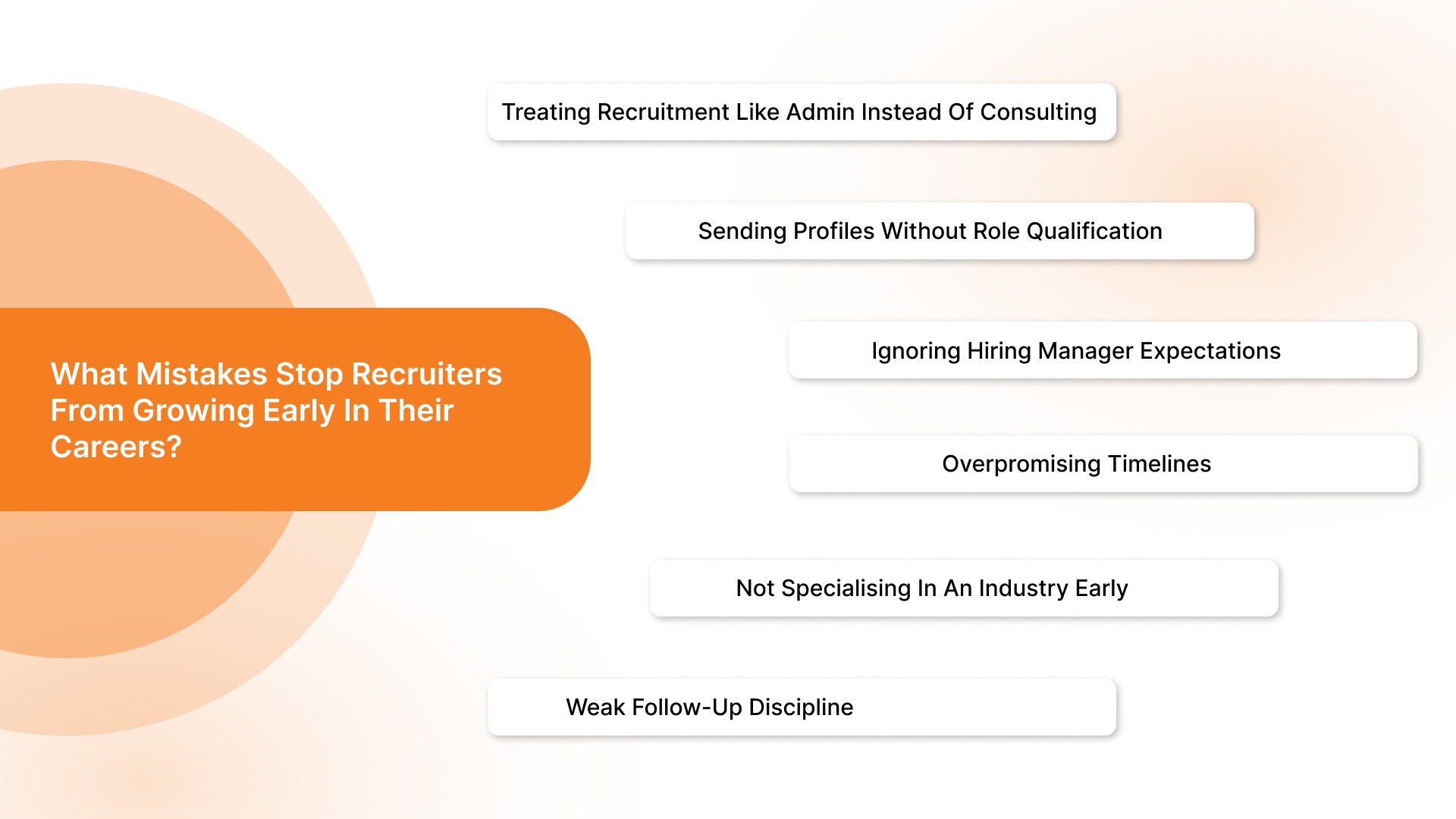
What Mistakes Stop Recruiters From Growing Early In Their Careers?
Most early-career recruiters do not struggle because the job is complex. They struggle because they work without a repeatable placement system.
Industry compensation benchmarks show that new recruiters typically complete 0.5 to 1.5 placements per month in their first year, compared with 2 to 3 placements per month for stable performers.
1. Treating Recruitment Like Admin Instead Of Consulting
Recruitment fails when consultants behave like coordinators instead of interpreters of hiring intent. Clients expect judgment on role feasibility, not document forwarding.
This mistake usually appears as:
- Sending CVs without explaining strengths and risks.
- Avoiding compensation alignment conversations.
- Accepting unclear job descriptions.
- Waiting for feedback instead of shaping it.
Example
A hiring manager is seeking a data engineer who will own a streaming pipeline. An administrative recruiter submits ETL developers. A consulting recruiter confirms Kafka exposure before sourcing begins.
2. Sending Profiles Without Role Qualification
Unqualified submissions damage credibility quickly. Hiring managers remember irrelevant shortlists longer than strong ones.
Role qualification should confirm:
- Reporting structure clarity.
- Interview panel composition.
- Compensation flexibility range.
- Non-negotiable technical expectations.
Consultants who clarify these inputs early significantly reduce interview waste.
3. Ignoring Hiring Manager Expectations
Job descriptions rarely accurately reflect decision criteria. Hiring managers evaluate risk, ownership scope, and team fit before technical skill depth.
Signals' expectations were missed:
- Interview panels request replacement profiles repeatedly.
- Feedback arrives late or incomplete.
- Candidate rejection reasons shift mid-process.
Example
A cybersecurity hiring brief mentions SOC monitoring. The actual expectation is threat hunting ownership. Only conversation reveals this difference.
4. Overpromising Timelines
Timeline optimism weakens client confidence faster than shortlist delays.
Recruiters often promise:
- Unrealistic submission windows
- Inflated pipeline readiness
- Immediate replacement candidates
Permanent placement fees often range from 15% to 30% of the first-year salary, meaning each shortlist represents a measurable business cost for the client. Timeline accuracy protects long-term mandates.
5. Not Specialising In An Industry Early
Generalist recruiters compete on speed. Specialist recruiters compete on credibility.
Industry focus improves:
- Sourcing precision
- Compensation forecasting
- Shortlist acceptance rates
- Hiring manager trust
Example
Cloud infrastructure hiring differs sharply from analytics hiring. Certification mapping matters in one. Stakeholder ownership matters in the other.
6. Weak Follow-Up Discipline
Most placements are lost between the completion of the interview and acceptance of the offer.
Common follow-up failures include:
- Not checking competing offers.
- Ignoring relocation hesitation.
- Missing notice period risks.
- Delaying post-interview engagement.
Structured follow-up converts interviews into hires.
Also Read: Understanding Payroll Deductions and Their Types
How Do You Move From Recruiter To Trusted Hiring Advisor?
The shift from recruiter to advisor happens when consultants stop reacting to job descriptions and start shaping hiring decisions. This transition increases role ownership and access to leadership mandates.
Understanding Business Hiring Goals Instead Of Job Descriptions
Job descriptions describe tasks. Business goals describe outcomes.
Advisory recruiters clarify:
- Why does the role exist?
- What problem does the hire solve?
- What would failure look like after six months?
Example
A product hiring mandate may actually reflect roadmap delay risk rather than headcount expansion.
Learning Workforce Planning Basics
Workforce planning connects hiring with growth forecasts. Recruiters who understand this can shorten hiring timelines.
Key planning indicators include:
- Team expansion phases
- Project delivery dependencies
- Replacement hiring risk
- Budget approval cycles
Recruiters who read workforce signals anticipate roles before they are published.
Reading Compensation Benchmarks
Compensation awareness prevents shortlist rejection before interviews begin.
Benchmarks should include:
- Competing offer ranges
- Geographic salary variation
- Contractor versus permanent tradeoffs
- Leadership premium bands
Supporting Leadership Hiring Conversations
Leadership hiring depends less on skill matching and more on organisational alignment.
Consultants supporting leadership searches:
- Map succession pipelines
- Evaluate reporting influence
- Interpret team maturity gaps
- Assess change management expectations
This exposure shifts recruiter positioning quickly.
Managing Multi-Role Hiring Programs
Multi-role mandates require sequencing instead of parallel sourcing.
Program ownership includes:
- Dependency mapping across roles
- Staggered shortlist planning
- Stakeholder scheduling alignment
- Offer acceptance coordination
Recruiters handling coordinated hiring waves gain strategic visibility earlier in their careers.
Working With GCC Expansion Hiring Environments

Global capability centre hiring introduces structured scaling patterns across engineering, analytics, cloud, and AI teams. Recruiters in these environments learn to cluster roles rather than make isolated placements.
Enterprise hiring ecosystems such as V3 Staffing often involve coordinated hiring across specialised domains, including engineering, data platforms, infrastructure architecture, and machine learning delivery teams. Exposure to such programs helps consultants transition from profile-submission roles to workforce-advisory support across expansion phases.
Is Recruitment The Right Career For You? A Practical Self Assessment Checklist
Recruitment rewards people who enjoy decision ownership and performance visibility. It is not suited to candidates seeking predictable output-based work.
Use the checklist below to honestly evaluate fit.
Do You Enjoy Targets And Performance Metrics?
Recruitment performance is transparent. Activity converts directly into placements.
Recruiters in commission-structured agencies often earn 10% to 40% of placement fee revenue, linking income directly to delivery outcomes.
Indicators this suits you:
- You track progress daily
- You enjoy measurable output
- You prefer incentive-based income
Are You Comfortable With Rejection Cycles?
Candidate drop-offs and client delays are routine. Consultants who recover quickly maintain pipeline stability.
Signals this environment fits you:
- You restart sourcing immediately after rejection
- You maintain outreach consistency
- You separate activity from outcome emotionally
Can You Manage Multiple Hiring Pipelines Simultaneously?
Agency recruiters commonly manage parallel mandates across companies and functions.
Typical workload includes:
- Multiple sourcing streams
- Overlapping interview cycles
- Competing offer closures
Pipeline tracking discipline determines placement stability.
Are You Willing To Specialise In An Industry Domain?
Specialisation improves placement credibility and earnings predictability.
Common specialisation paths include:
- Engineering hiring
- Product hiring
- Data and analytics hiring
- Cloud infrastructure hiring
- AI talent hiring
- Cybersecurity hiring
Domain depth increases mandate quality over time.
Do You Enjoy Relationship-Driven Work More Than Process-Driven Work?
Recruitment depends on trust cycles rather than workflow automation.
Strong indicators include:
- Maintaining long candidate conversations
- Tracking career moves across years
- Supporting hiring managers repeatedly
Relationship memory converts into repeat placements.
Career Progression Ladder In Recruitment
Recruitment progression follows measurable responsibility expansion.
Career growth accelerates when consultants move from role fulfillment to ownership of the hiring program.
Commission Structure Overview
Recruitment income typically combines base salary and placement incentives.
Common earning components include:
- Placement fee share
- Retention bonus eligibility
- Replacement guarantee adjustments
- Tiered revenue thresholds

How V3 Staffing Exposure Helps Recruiters Build Stronger Placement Judgment
Recruiters grow faster when they work within structured hiring programs that involve multiple stakeholders, role clusters, and delivery timelines, rather than single-placement execution. V3 Staffing, with 16+ years of recruitment experience, 10,000+ specialists hired, and 300+ clients served, operates across enterprise hiring environments that expose consultants to coordinated talent acquisition across engineering, product, data, cloud, AI, and cybersecurity roles.
Key service exposure areas include:
- Permanent Recruitment: Supports structured hiring across mid- and senior-level roles, where shortlist relevance directly affects closure speed and hiring manager confidence.
- Contract Staffing: Enables rapid workforce scaling to meet project timelines, address replacement hiring gaps, and expand temporary capability without long onboarding cycles.
- Leadership Hiring: Focuses on CXO and senior leadership search through targeted mapping, competency evaluation, and stakeholder alignment across decision layers.
- Recruitment Process Outsourcing (RPO): Embeds recruiters inside enterprise hiring workflows to manage sourcing pipelines, screening operations, and interview coordination across multi-role hiring programs.
- Employer Of Record (EOR): Supports compliant workforce deployment in new markets by managing payroll, statutory requirements, and employment administration without local entity setup.
Conclusion
Recruitment is shifting from resume matching to talent strategy. Consultants who understand workforce planning, specialist hiring, and stakeholder expectations will stay relevant as organisations expand across engineering, data, cloud, and AI teams. The strongest recruiters are those who move beyond filling roles and start shaping hiring outcomes.
If you want exposure to structured enterprise hiring programs and faster learning across permanent, contract, leadership, RPO, and EOR delivery models, connect with V3 Staffing to explore how experienced recruitment environments can accelerate your growth as a trusted hiring consultant.